
The Environment and Public Health Organization (ENPHO), in collaboration with Shanti Nepal, successfully organized a three-day training on “Introduction to Faecal Sludge Management (FSM) and Citywide Inclusive Sanitation (CWIS)” from June 11 -13, 2025, at Hotel Sarathi, Dhadingbeshi, of Dhading District.
The event involved the active participation of 21 representatives from various municipalities of Dhading and Gorkha Districts, including Nilkantha, Dhunibeshi, Jwalamukhi, Gajuri, Benighatrorang, and Aarughatghat. Additionally, team members from Shanti Nepal, Focus Nepal, and Community Transformation Society were also present.
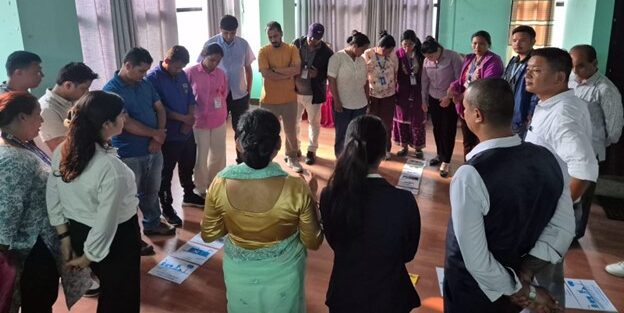
Participants forming a chain from sanitation service components |
The training aimed to strengthen participants’ understanding of FSM and CWIS to support the development of equitable and sustainable sanitation systems in urban settings. Key topics covered included global and national sanitation scenarios, CWIS concepts and frameworks, safe handling across the FSM service chain—such as emptying, transport, treatment, and reuse or disposal—as well as design principles, health and environmental impacts, and financial considerations. Participants also explored faecal sludge quantification, containment, desludging, treatment technologies, stakeholder roles, and financial flows in FSM systems.
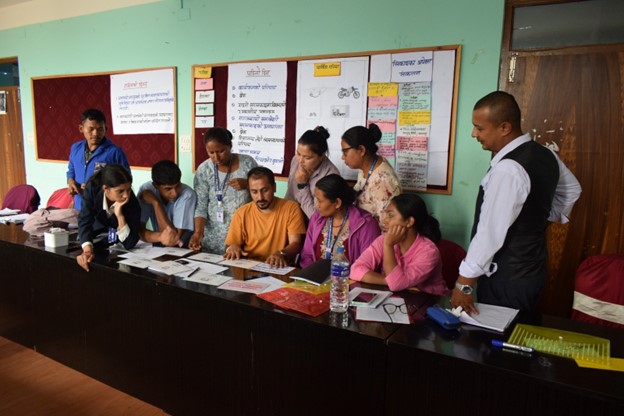
Participants discussing the CWIS framework |
Delivered through a participatory approach, the training featured group discussions, experience sharing, presentations, brainstorming sessions, and video screenings, promoting practical learning and peer engagement.
Reflection from participants
“With municipal council meetings currently underway, the knowledge gained from this training will be very useful in guiding our discussions and decisions on Faecal Sludge Management (FSM),”

Pratikshya Aryal,
Sub-Engineer
Dhunibeshi Municipality, Dhading
“Our Rural Municipality was recently declared as a ‘Clean Village’ and is now progressing toward achieving total sanitation. This training has strengthened our understanding of safe faecal sludge management, and I am confident that, moving forward, we will be able to handle faecal sludge more effectively and safely in our municipality.”
Shaligram Dhakal,
Community Health Facilitator
Community Transformation Society Nepal (CTS), Dhading
The training served as an important step toward enhancing local capacity in managing urban sanitation challenges. By equipping municipal representatives and development partners with practical skills and knowledge, the training is expected to enhance the planning, implementation, and monitoring of faecal sludge management (FSM Participants developed specific action points to raise FSM-related issues during municipal council meetings, encourage the use of septic tanks, and carry out awareness activities at both municipal and community levels. These efforts will support the broader goal of achieving safe, equitable, and sustainable sanitation for all.